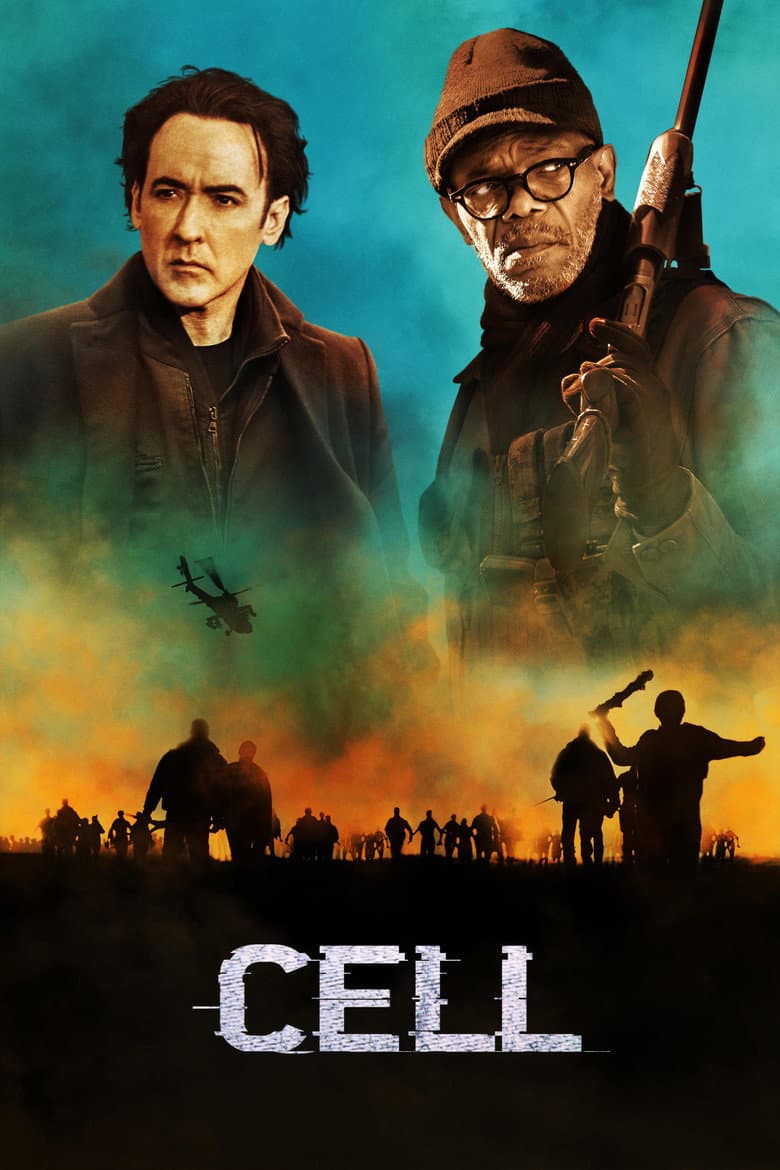
Cell(2016)
Director
Tod WilliamsCast
John Cusack as Clayton 'Clay' Riddell, Samuel L. Jackson as Thomas 'Tom' McCourt, Isabelle Fuhrman as Alice Maxwell, Owen Teague as Jordan, Clark Sarullo as Sharon Riddell
📝 剧情简介📝 Overview
当一种神秘信号通过全球手机网络传播时,一场毁灭性的暴力疫情随之爆发——手机用户瞬间变成嗜血狂暴的“手机人”,失去理智并疯狂攻击他人。在新英格兰地区,漫画家克莱·里德尔(约翰·库萨克饰)在混乱中幸存,并与同伴汤姆和爱丽丝组成小队,试图穿越废墟般的城市,寻找安全的避难所。他们发现手机信号不仅改变了人类行为,还催生了一种集体意识,将受害者变成无灵魂的“蜂群”。随着文明崩溃,幸存者不仅要躲避“手机人”的攻击,还要面对更可怕的真相:信号只是某种进化实验的开端,而人类正面临被彻底取代的命运。When a strange signal pulsates through all cell phone networks worldwide, it starts a murderous epidemic of epic proportions when users become bloodthirsty creatures, and a group of people in New England are among the survivors to deal with the ensuing chaos after.
📝 评价分析📝 Review & Analysis
Director Todd Williams (of the *Paranormal Activity* franchise) attempts to compress the sci-fi horror core of Stephen King's original novel into a 90-minute commercial film, but the execution falls short. The first half effectively builds tension with its apocalyptic dread and metaphors for smartphone dependency, particularly through John Cusack's portrayal of an ordinary father, whose despair and resilience resonate deeply. However, the second half loses control of pacing, and the CGI effects are crude (such as the "phone people" swarm scenes), undermining the philosophical depth of "technology alienating humanity" present in the source material. As an adaptation, *Cell* fails to capture the nuanced psychological depiction of "gradual collapse" in King's novel, instead devolving into a mediocre zombie film. Within the horror genre, it lacks the suspense of *The Mist* and falls short of the epic scope of *The Stand*, ultimately becoming an underrated yet underwhelming adaptation.
🎭 Full Cast
Clayton 'Clay' Riddell
Thomas 'Tom' McCourt
Alice Maxwell
Jordan
Sharon Riddell
Denise
Charles Ardai
Chloe
Geoff
📖 与原著的主要差异📖 How It Differs From the Book
The original work ends with an open-ended conclusion, where the survivors face the ambiguous possibility of "evolution." In contrast, the film adapts a more traditional, sentimental ending where "the hero detonates the signal source and sacrifices himself," which dilutes Kim's pessimistic undertones.
In the original novel, Alice is a 16-year-old girl, with her innocence and growth arc being key elements; in the film, she is changed into an adult woman (played by Isabelle Fuhrman), and the depth of the character is reduced to that of a functional supporting role.
The novel meticulously depicts the evolution of "phone people" from individual to collective consciousness, incorporating numerous psychological thriller elements; the film omits this groundwork, jumping directly to swarm behavior, resulting in a logical disconnect.
The original novel blends technophobia, social satire, and existential contemplation, embodying King’s signature "everyday horror" style; the film leans closer to traditional zombie movies, emphasizing action scenes over psychological tension.
Key plot points in the novel, such as the "Phone People" transmitting information through dreams and the philosophical debate between the protagonist and the antagonist "Prophet," have been completely removed, resulting in a shallower theme.